Huw Rees Octet and The Return of Mike Fletcher

July 10th, 2009

I caught the weekly Cobweb Collective session at The Yarbird last night.  There was a good laid back first set from a trio led by saxophonist Ben Bryden with Rob Anstey on bass and Ben Kane on drums.  This was followed by a very interesting and enjoyable main set from the Huw Rees Octet.  Huw is a pianist but composition is his main focus and he has been working on a number of original tunes and arrangements of standards for over a year now.  With support from Birmingham Jazz, he has been studying counterpoint with contemporary classical composer Richard Causton and this was the first time I had heard the results.  The writing is extremely interesting with heavy use of counterpoint on most of the material.  There was more than a hint of both Gil Evans and the West Coast 1950s style, but there was something very original about the way the tunes started slowly and gradually built up to a quite rich and densely organised climax.  The octet is a heavyweight band of top students and graduates from the jazz course at the Conservatoire and they handled the complex material quite effectively, but will need to feel their way into building solos appropriate to the writing.  The Octet will be at the Rush Hour Blues session at Symphony Hall on Friday 17th July (5.30).

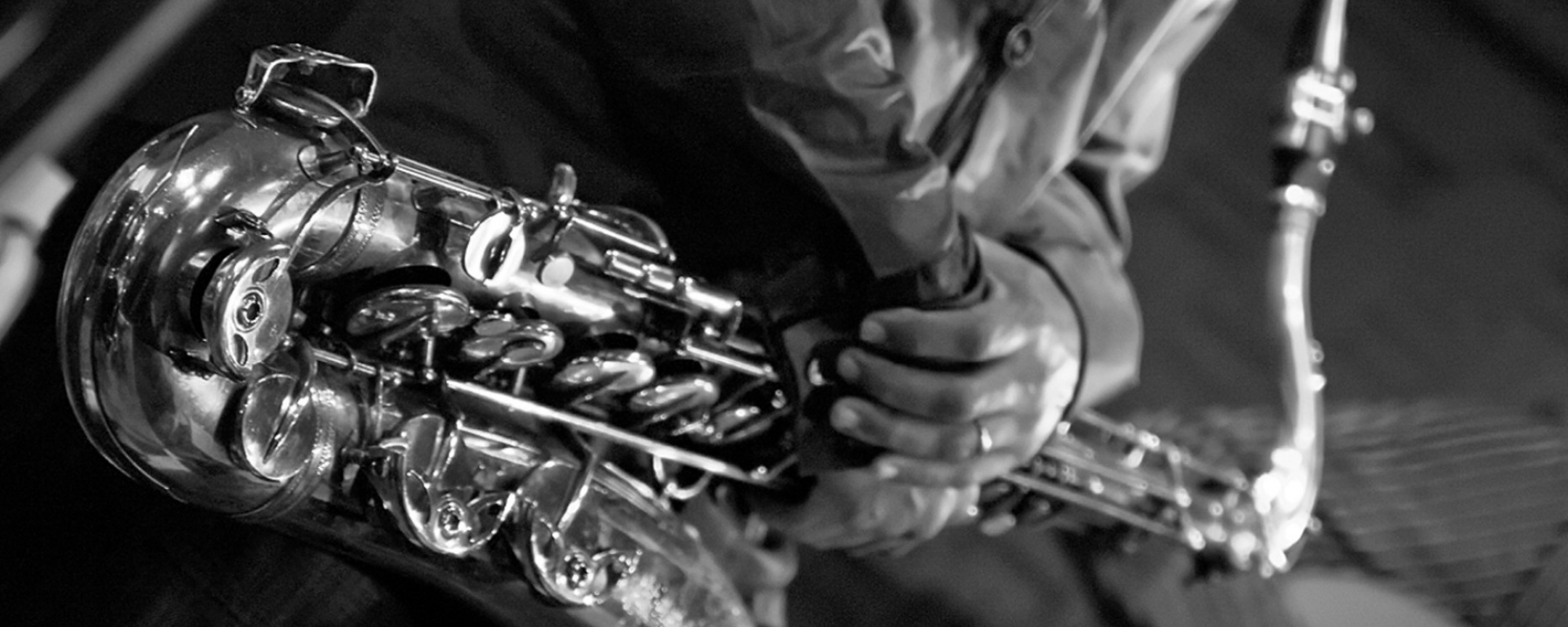
There was a very special surprise in the final set with Mike Fletcher sitting in with the Ben Bryden Trio at the end of the night.  As reported in a blog a year or so ago, Mike has had to retire from regular playing because of repetitive strain problems with his arm and has taken up teaching of both music and English as a Foreign Language.  He has been hanging out in Berlin, reputedly the cheapest capital in Europe, for nine months or so, teaching and checking out the very interesting local music scene.  Mike played just two numbers, but seems to have retained his fluency and bite on the alto saxophone. Indeed I thought his tone was stronger and his statements punchier than when I last heard him.  Nice that his characteristic slow build up is still there as well as the occasional display of disgust at his own playing.  It was good to hear him again and apparently he will be be playing on an occasional basis.  he is, for example, playing with The Sub Ensemble in the Manchester Jazz Festival at the end of July.

Tony

Pre-order your Birmingham Jazz Youth Group CD

July 7th, 2009

We are delighted to announce the release of the Birmingham Jazz Youth Group live CD recorded this Spring.

Following a fantastic weekend session of group improvisation the recording features the Family Concert at the CBSO Centre on Saturday 25th April .The CDs will be available from this Friday 10th July at Rush Hour Blues at the Symphony Hall Foyer where the Youth Group will be performing.The gig is from 5.30pm - 7pm and is free entry.

To pre- order your CD please send an email to info@birminghamjazz.co.uk and we will reserve you one of the limited edition copies.

The CDS will be priced at £10.00 and all proceeds will go to the Birmingham Jazz Education Fund.

http://www.thsh.co.uk/rush-hour-blues-summer-2009

Twelves Trio @ Jazz Club 27th May 2009

July 7th, 2009

We’re back with another Podcast. This time it’s the turn of Twelves Trio (who aren’t really a Trio at all) who were our guests at Jazz Club in May. We bring you “Candle” written by Tenor player Mark Hanslip from the band’s set. If you enjoy this taster podcast, you can listen to the whole gig at http://www.birminghamjazz.co.uk/jazzclub.htm#tt

Remember that The Rainbow, the home of Jazz Club, is still being threatened by closure due to a EPA Abatement order. Please do all you can to keep this cultural hub alive and well. :-)

 Candle

Youth Group at Rush Hour Blues this Friday

July 6th, 2009

The ever evolving Birmingham Jazz Youth Group have established themselves as a semi-professional ensemble performing their blend of free improvisation and grooves across the city. Hear them for free at the hugely popular Rush Hour Blues session at Symphony Hall Foyer this Friday 10th July at 5.30pm -7pm.

http://www.thsh.co.uk/rush-hour-blues-summer-2009

Glasgow Jazz Festival

June 29th, 2009

I have just spent the weekend up in Glasgow as guest of the Jazz Festival for their Homewgrown Showcase of Scottish jazz musicians.  I have been up a few times before, and worried about the attendances.  But this time audiences were well up and I got the impression that this year’s stronger Scottish jazz focus somehow chimed in with the increasingly strong Scottish identity arising from devolution and all that, and drew the crowds.  Part of the reason must also be the great venues they were using this year, all in the very attractive Merchant City part of Glasgow.  The main large venue, apart from the Concert Hall, is the Old Fruitmarket which still has all the old signs up and a bit of a feel of a market, but makes a great venue.

I’m told that Scottish traditional music really developed in the late 90s at the time of devolution and many Scottish players seem to divide their time between jazz and traditional music.  This often results in a very interesting and successful blend of the two styles.  Trumpeter Colin Steele does this very effectively in a quintet that also features Dave Milligan on piano and Phil Bancroft on saxophones.  But, for me, the most enjoyable gig of the weekend came from a sextet led by drummer Stu Brown who recreate the music of Raymond Scott.   Raymond Scott led a sextet in New York in the 1930s that gained a certain popularity for very clever themes that weren’t reallly jazz, but drew on its harmonies and rhythms.  These themes then became the music for cartoon films with the likes of Bugs Bunny, Daffy Duck and even, more recently, the Simpsons.  Anyway the music is great fun and extremely well played by Stu Brown’s Raymond Scott Sextet.  I hope we can get the group down to this part of the world sometime.

Tommy Smith was very much to the fore leading both the Scottish Youth Jazz Orchestra with lots of Birmingham Conservatoire students and graduates and the Scottish National Jazz Orchestra playing Tommy’s rearrangement for jazz big band of Gershwin’s Rhapsody in Blue with Brian Kellock as soloist on piano.

Other bands to look out for are the Paul Towndrow Quartet and the Ryan Quigley Big Band.

Tony

Jazz is the word

June 29th, 2009

Satisfy your curiosity over what jazz is in 2009 and have a read of the results of prolific jazz blogger Peter Bacon’s recent poll on what this music is called “jazz”.

http://thejazzbreakfast.wordpress.com/2009/06/27/jazz-is-still-the-word-oh-yes/

Have your say and comment below.

From thejazzbreakfast

The voting on this site is over, and the 11% who feel jazz is no longer the right word to describe the wide diversity of the music you sometimes find in that section in the record shop (OK, online!) have been soundly trounced by the 66% who feel there is nothing wrong with the word jazz. And I reckon the Paul Simon fans (”I can call you Betty and you can call me Al”) who came in second at 23% would probably lean in the jazz direction had there been second place voting rules.

Kevin Le Gendre summed it up perfectly in the liner notes to his new compilation Now’s The Time II – and you can read them in my review here.

I quite understand the point Stuart Nicholson was making in a recent Observer review of new discs by Acoustic Ladyland and Troyka. He alluded to Ladyland main man Pete Wareham’s wariness of the label because it ends up keeping his music away from a rock crowd, which is the one Wareham feels is its natural audience (I am making assumptions here and am happy to be put right if this is not the case).

And I understand that survival and one’s own career need to come first. But, taking the bigger view, both Nicholson and Wareham would be better served, I reckon, showing some allegiance to the history and faith in the concept of jazz, surely? That is what has inspired them to get to where they have got to today. And if they feel that is not where their natural audience now resides, surely it’s time to bring their audience into the house of jazz, not leave it.

It was the same story with Soweto Kinch and his frustration at not having his CDs in the hip-hop racks. But, a vague awareness of the coverage Kinch has received over the years (no accurate research or survey here) would suggest that most of the coverage he gets is in the jazz media. It’s difficult enough being a musician. There’s no need to add to the anguish by rejecting the followers you do have in order to go after ones you might not get, or certainly not in great enough numbers. Babies and bathwater seem to apply.

I don’t think Ornette Coleman is particularly embarrassed about being referred to as a jazz musician, is he? I’m not sure that John Zorn is, and I don’t think Derek Bailey was either. And that jazz can encompass Peter Brotzmann and Frank Sinatra is, to my mind, cause for celebration, not alarm. Surely to make whatever music is in your heart and mind and then add jazz to it as a label of convenience is to say all the right things about it? About its freedom, about its honesty, about its sincerity, about its dedication to tackling the most important and difficult challenges in music – that of spontaneous composition.

Jazz has always been a broad church – let’s just keep throwing its doors wide open and inviting everyone in.

“Essential breeding ground for talented musicians”

June 26th, 2009

BBC Midlands Today have reported on the huge public support for the Save The Rainbow Campaign following the Noise Abatement Order issued  to the home of Jazz Club. Click on the link below to see the full report broadcast on BBC Midlands Today.

http://news.bbc.co.uk/1/hi/england/8119566.stm

The Convergence Quartet @ Jazz Club 29th April 2009

June 23rd, 2009

We return to our podcast series with a track from The Convergence Quartet recorded at Jazz Club this April. For the full gig head over to our Jazz Club page:

http://www.birminghamjazz.co.uk/jazzclub.htm

You’ll find all of the gigs in our series there. For those of you who don’t know The Rainbow (where we hold Jazz Club) is under serious threat of closure so please do all you can to support it. Next up: Twelves Trio, and we promise you won’t have to wait so long for the next one!

 The Convergence Quartet

International Jazz Collaboration at Birmingham Conservatoire

June 23rd, 2009

As part of this year’s New Generation Arts Festival at Birmingham Conservatoire, three international groups were formed with students from the jazz courses at Paris Conservatoire, the Carl Nielsen Academy in Odense, Denmark and Birmingham Conservatoire.  There were three students from Paris, three from Denmark, one of whom is actually Polish, but studying in Odense, and nine from Birmingham.  They were formed into three quintets and arrived last Friday, rehearsed intensively over the weekend and performed last night in the Conservatoire’s Adrian Boult Hall.  All of this was put together by the Conservatoire with support from Birmingham Jazz.

The concert last night was a very successful event; each group seemed to have worked well and indeed had a ball of a time working intensively over two days with some input from two tutors and a run through during the day on Monday in a Performance Platform type situation with tutors before the evening concert.  Group B with Kieron Macintosh (UK) trumpet, Geoffroy Gesser (France) sax, Toby Boalch (UK) piano and Fender Rhodes, Emil Brun (Denmark) bass and Chris Draper (UK) drums were the first to play.  The band had a good feel with strong interaction between Emil on bass and Chris on drums, and good rapport between Kieron on trumpet and Geoffroy on sax.  The group played a number of excellent if rather cerebral tunes by Geoffroy.

Second up was Group C with Rachel Cohen (UK) alto sax, Tomasz Licak (Poland and Denmark) tenor sax, Vladimir Medail (France) guitar, Nick Jurd and Jonathan Silk (both UK) on bass and drums respectively. This was the most straightahead group with a good swing and excellent solos from all members, especially Vladimir on guitar.

The evening was rounded off by Group A with Luis Mather and Nick Dunham (both UK) on tenor sax and trumpet respectively, Romain Clerc-Renaud (France) on piano, Tim Thornton (UK) bass and Rasmus Schmidt (Denmark) on drums.  This group had a good mixture of free material with a definite steamer to finish off with.  Each soloist was very impressive; I know and always enjoy Luis’ playing, it was good to hear Nick stretch out a bit on the free passages and I was very impressed with Romain on piano.

This was a very successful experiment, both in bringing together players from three settings and in showing that if you put together musicians for an intensive playing/rehearsal session, they will have a great time and come up with some excellent music.

Tony

The Final Night of Ornette Coleman’s Meltdown

June 23rd, 2009

The final night of Ornette’s Meltdown was a very moving experience.  What struck me most, especially about the final night, but also about the previous evenings I had been down to, was the very strong feeling of warmth towards ornette and his music.  Of course, much of that comes from respect for a man in his 79th year, but it is so much more than that.  The Royal Festival Hall has been more or less full throughout Meltdown and the bars and Clore Ballroom running afternoon and pre-concert events, have been buzzing too, and the heaving RFH had a wonderful atmosphere on Sunday’s night’s final concert; at the end people were crying out ‘We love you, Ornette’ and people rushed up to the stage to shake his hand at the end.  Yes there is respect for age, but, in fact, it seems mostly to be coming from an acceptance that Ornette is a humble man who has had a massive influence, not just on jazz where the influence is clear, tangible, even if still somewhat controversial, but on other musics too, at least in terms of approach and philosophy.

All this was very much in evidence in the varied programme of Sunday night.  The core of the evening was the quartet with Tony Falanga on double bass, Al McDowall on electric bass and Ornett’e son and manager Denardo Coleman on drums; they played a number of Ornette’s tunes and other material including Bach’s Cello Suite no 1. Each tune was played very accurately and the very fast jazz tunes with great precision so much so they occasionally they stopped and congratulated each other before continuing into the solos. The solos were mostly from Ornette, sharp and to the point.  They were joined after a while by Flea, bass guitarist with the Red Hot Chili Peppers, who seemed deeply into the music, knew all the tunes extremely well and made an excellent contribution.  All of this would have made for a great gig, but there was so much more.  Baaba Maal came on and sang a beautiful and haunting song, the Master Musicians of Jojouka from Morocco played the opening set and then returned to jam with the quartet.  This had happened on the Friday too, but this time Ornente’s playing intermeshed with their wailing sounds and rhythms really well and this was undoubtedly a highlight of the show.  But the real highlight was the appearance for the encore of Charlie Haden, who, as reported in a previous blog, was so frustrated at not playing with Ornette on the Saturday.  He and Ornette duetted on Lonely Woman, with a little bit of accompaniment from Denardo on drums.  They probably played for about 15 mins and it was just amazing.